How to Practice With a Metronome
If you are learning to play drums, one of the most useful tools you can practice with is a metronome.
A metronome gives you a steady click that helps you keep a consistent tempo while you play. At first, practicing with a metronome can feel difficult. You may find yourself playing ahead of the click, falling behind it, or losing the beat completely when you try a new drum pattern.
That is completely normal.
Learning to play with a metronome is a skill, just like learning a new drum beat or rudiment. The more you practice, the easier it becomes to feel the pulse and keep your playing steady.
In this guide, you will learn how to practice drums with a metronome, how to choose the right BPM, how to start simple, and how to gradually improve your timing. We will also look at common beginner mistakes and several practical exercises you can use in your daily drum practice.
What Is a Metronome?
A metronome is a tool that produces a regular clicking sound at a selected speed.
The speed is measured in BPM, which means beats per minute.
For example:
- 60 BPM = one click every second
- 80 BPM = 80 beats every minute
- 100 BPM = a faster tempo
- 120 BPM = two beats every second
When you practice drums with a metronome, the click acts like a musical clock. Your job is to play in time with it.
You can use a metronome with almost anything you practice: drum grooves, fills, rudiments, singles, doubles, paradiddles, coordination exercises, and even songs.
Why Should Drummers Practice With a Metronome?
Good timing is one of the most important skills a drummer can develop.
A drummer does not simply need to hit the correct drums. You also need to hit them at the right moment.
You might know a drum beat perfectly, but if your tempo constantly speeds up and slows down, the groove will not feel solid.
Regular drum timing practice helps you develop:
- Better internal timing
- More consistent tempo
- Better coordination
- Cleaner drum grooves
- More controlled fills
- Better rhythm awareness
- Stronger musical confidence
A metronome also shows you something that can be difficult to notice by yourself: whether your tempo is actually stable.
You may think you are playing at 90 BPM, but after a few bars you might slowly move to 95 BPM. When you practice with a click, you can hear and feel those changes.
How to Start Practicing Drums With a Metronome
If you are a beginner, don't start by choosing a very fast tempo.
The goal is not to impress yourself with how fast you can play. The goal is to develop accurate and consistent timing.
Start with a comfortable tempo, such as 60–80 BPM.
Sit comfortably at your drum kit or practice pad and let the metronome play for a few seconds before you start.
First, simply listen.
Try tapping your foot along with the click. Do not play anything yet.
Once you can comfortably feel the pulse, start playing simple notes.
This first step may seem too easy, but it is important. You are learning to connect the sound of the click with your own internal sense of time.
Exercise 1: Play Quarter Notes
Let's start with one of the simplest metronome exercises.
Set your metronome to 60 BPM.
Play one note for every click.
For example, play a single stroke on the snare:
Count:
Continue for several minutes.
Try to make every note the same distance from the next note.
Do not rush to increase the tempo.
Listen carefully to the relationship between your drum hit and the metronome click.
If your playing sounds like:
you are probably playing with the pulse.
If it sounds like:
you may be playing slightly late.
If it sounds like:
you may be playing ahead of the beat.
The goal is to make the click and your playing feel like one steady pulse.
Exercise 2: Practice Eighth Notes
Once quarter notes feel comfortable, move to eighth notes.
Keep the metronome at 60 BPM.
Now play two notes for every click.
Count:
The metronome clicks on:
Your drum hits happen on:
This exercise teaches you how to divide the space between the metronome clicks.
This is extremely useful because many common drum grooves use eighth-note hi-hat patterns.
Try playing alternating right and left hand strokes:
Keep the notes even and relaxed.
Do not worry about speed.
At this stage, accuracy is much more important than BPM.
Exercise 3: Play a Basic Drum Groove
Now let's use the metronome with a simple rock groove.
Set the metronome to around 70 BPM.
Play eighth notes on the hi-hat.
Play the bass drum on beats 1 and 3.
Play the snare on beats 2 and 4.
Count:
Your basic groove becomes:
- Hi-hat: 1 & 2 & 3 & 4 &
- Kick: 1 and 3
- Snare: 2 and 4
Loop this pattern for several minutes.
Try not to think about every individual limb. Instead, listen to the whole groove.
This is where metronome practice starts becoming musical.
Exercise 4: Practice Playing on the Click
Another important skill is learning to place your notes directly on the metronome click.
Set the metronome to 80 BPM and play quarter notes on the snare.
Listen carefully.
You want your drum hit and the metronome click to happen at almost exactly the same time.
When your timing is good, the click may almost disappear behind your drum sound.
This is a great feeling.
However, don't worry if you cannot do it immediately. Developing this accuracy takes time.
Exercise 5: Practice Kick and Snare Timing
Once you are comfortable with a basic groove, focus on your kick and snare placement.
For example, play:
over four quarter-note beats.
Then add eighth-note hi-hats.
The goal is to keep all three parts locked together while following the metronome.
This type of drum timing practice is especially useful for beginners because it combines coordination and timing.
Start slowly.
If you make mistakes at 100 BPM, lower the tempo to 70 BPM and try again.
Slow practice is not a waste of time. It gives your brain and muscles a chance to learn the movement correctly.
Exercise 6: Gradually Increase the BPM
One of the best ways to use a metronome is to gradually increase your tempo.
Suppose you can comfortably play a groove at 70 BPM.
Try 75 BPM.
If that feels good, try 80 BPM.
Then perhaps 85 BPM.
Do not increase the tempo just because you can physically play faster.
Increase it when you can play the pattern:
- Without stopping
- Without speeding up
- Without slowing down
- With relaxed technique
- With consistent volume
- With accurate timing
If the groove starts falling apart, go back to the previous tempo.
This approach is much more effective than constantly trying to play as fast as possible.
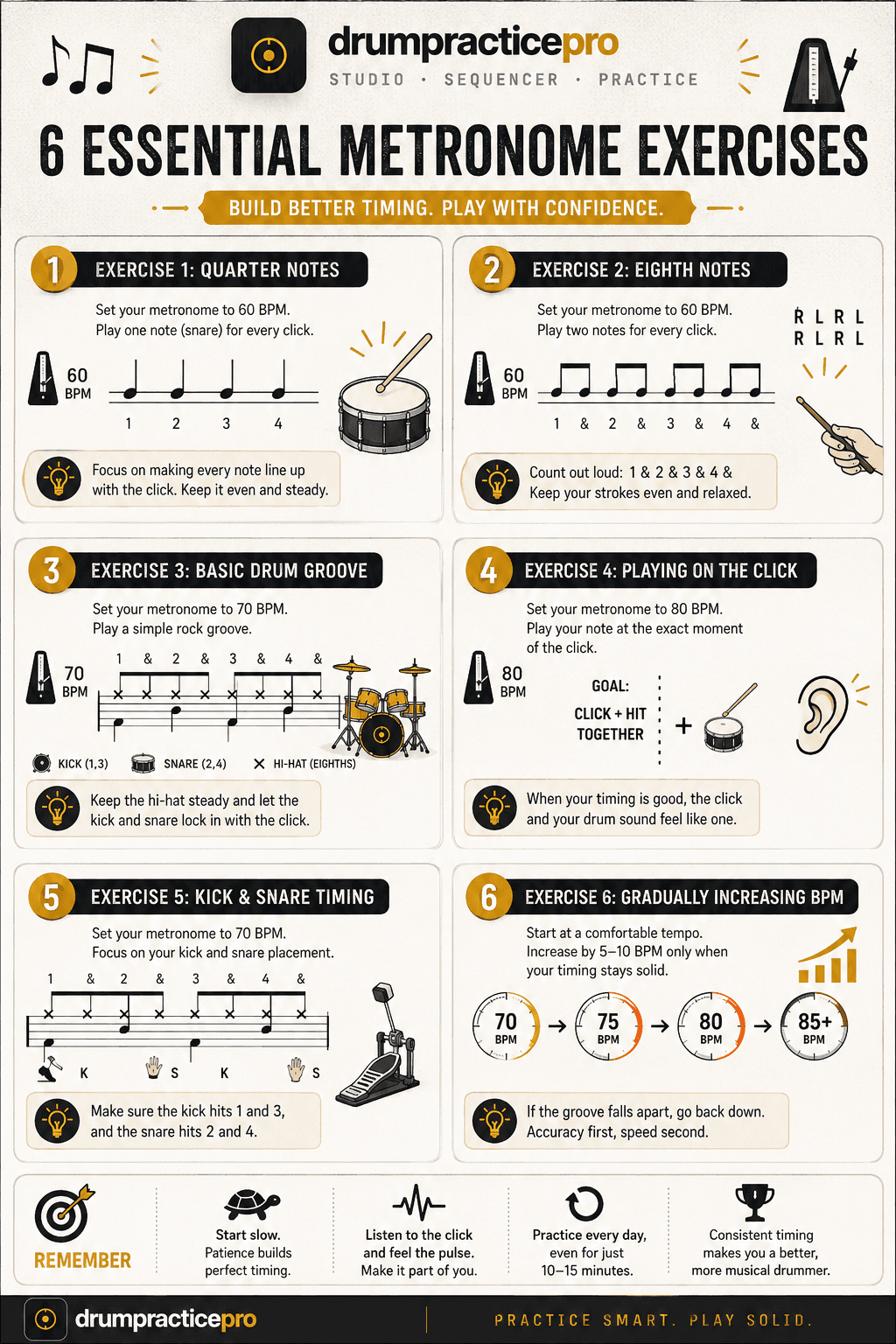
A quick-reference cheat sheet for the six metronome exercises above, with a tip for each one.
Using DrumPracticePro for Metronome Practice
A metronome becomes even more useful when you combine it with an actual drum pattern.
With DrumPracticePro, you can create or load a groove, set the tempo, and loop the pattern while you practice.
Instead of simply playing random exercises, you can work on a specific rhythm and repeat it until it feels comfortable.
For example, you can:
- Create a simple drum groove.
- Set the metronome to 70 BPM.
- Play the groove repeatedly.
- Listen carefully to your timing.
- Increase the tempo when you are comfortable.
- Repeat the process at 75, 80, 85 BPM and beyond.
You can also work with drum notation and experiment with different rhythms, accents, and sticking patterns.
This makes your metronome practice more structured.
Instead of thinking, "I should practice with a click today," you have a specific rhythm and tempo to work on.
Practice With Different Note Divisions
Once you understand basic quarter and eighth notes, start experimenting with different subdivisions.
For example:
Quarter notes
Eighth notes
Sixteenth notes
You do not need to play everything fast.
In fact, slow sixteenth-note exercises can be very useful.
The metronome gives you the main pulse while you learn to control the smaller subdivisions between each click.
This helps develop a stronger sense of rhythm and timing.
Try Playing Without the Metronome for a Moment
Once you become comfortable with a groove, try an interesting exercise.
Play with the metronome for four bars.
Then turn it off for four bars.
Keep playing the groove.
Then turn the metronome back on.
Did you stay close to the original tempo?
This is sometimes called gap click practice.
It helps develop your internal sense of time.
You are no longer relying completely on the metronome. Instead, you are learning to carry the pulse yourself.
Start with short gaps. As your timing improves, make the gaps longer.
Don't Always Practice at the Same Tempo
It is tempting to choose one BPM and stay there every day.
But your timing can improve faster if you practice at different tempos.
For example:
Playing slowly teaches control.
Playing at moderate tempos develops consistency.
Playing faster challenges your technique and coordination.
Changing tempos also helps prevent you from becoming comfortable with only one specific speed.
Common Beginner Mistakes
Starting Too Fast
This is probably the most common mistake.
A beginner learns a groove and immediately sets the metronome to 120 BPM.
The result is usually rushed playing, mistakes, tension, and frustration.
Start slower than you think you need to.
Trying to Follow Every Click
You don't need to consciously chase every metronome click.
The goal is to develop an internal pulse.
Listen to the click, feel the beat, and let your playing sit naturally inside that pulse.
Speeding Up During Fills
Many beginners can keep a steady groove but speed up when they play a fill.
Practice your fills with the metronome too.
Start with simple fills and make sure the first note of the next groove lands exactly where it should.
Slowing Down When Something Gets Difficult
When a difficult section appears, it is common to slow down without noticing.
The metronome helps expose this problem.
If this happens, lower the BPM and practice the difficult section separately.
Stopping After a Mistake
Do not stop every time you make a mistake.
Keep the metronome running and continue playing.
Making a mistake is part of practice. Learning how to recover without losing the pulse is an important drumming skill.
Only Practicing Fast
Fast playing can be exciting, but it does not automatically mean good timing.
Slow practice is one of the best ways to build accuracy.
A groove played perfectly at 70 BPM is more useful than a messy groove played at 140 BPM.
How Long Should You Practice With a Metronome?
You do not need to spend an entire practice session playing with a click.
Even 10–15 focused minutes can make a difference.
For example:
If you have more time, you can add rudiments, fills, subdivisions, or gap-click exercises.
The most important thing is consistency.
Practicing with a metronome for 15 minutes several times a week is more useful than doing one long session once a month.
A Simple Beginner Metronome Practice Routine
Here is a routine you can use in your next practice session.
Step 1 — Warm Up
Set the metronome to 60 BPM.
Play simple single strokes for two or three minutes.
Focus on relaxed hands and even notes.
Step 2 — Practice Subdivisions
Play quarter notes, then eighth notes.
Count out loud if necessary.
Make sure the notes stay evenly spaced.
Step 3 — Play a Basic Groove
Set the metronome to around 70 BPM.
Play a simple kick, snare, and hi-hat groove.
Loop it for several minutes.
Step 4 — Increase the Tempo
Increase the BPM by 5–10 beats.
Continue only if your timing remains consistent.
Step 5 — Practice a Fill
Add a simple one-bar fill.
Make sure you return to the groove on beat 1.
Step 6 — Try a Gap Click
Play with the metronome for a few bars.
Then continue without it.
When the click comes back, see how close you are to the original tempo.
This routine gives you a little bit of everything: timing, subdivisions, groove, coordination, fills, and internal pulse.
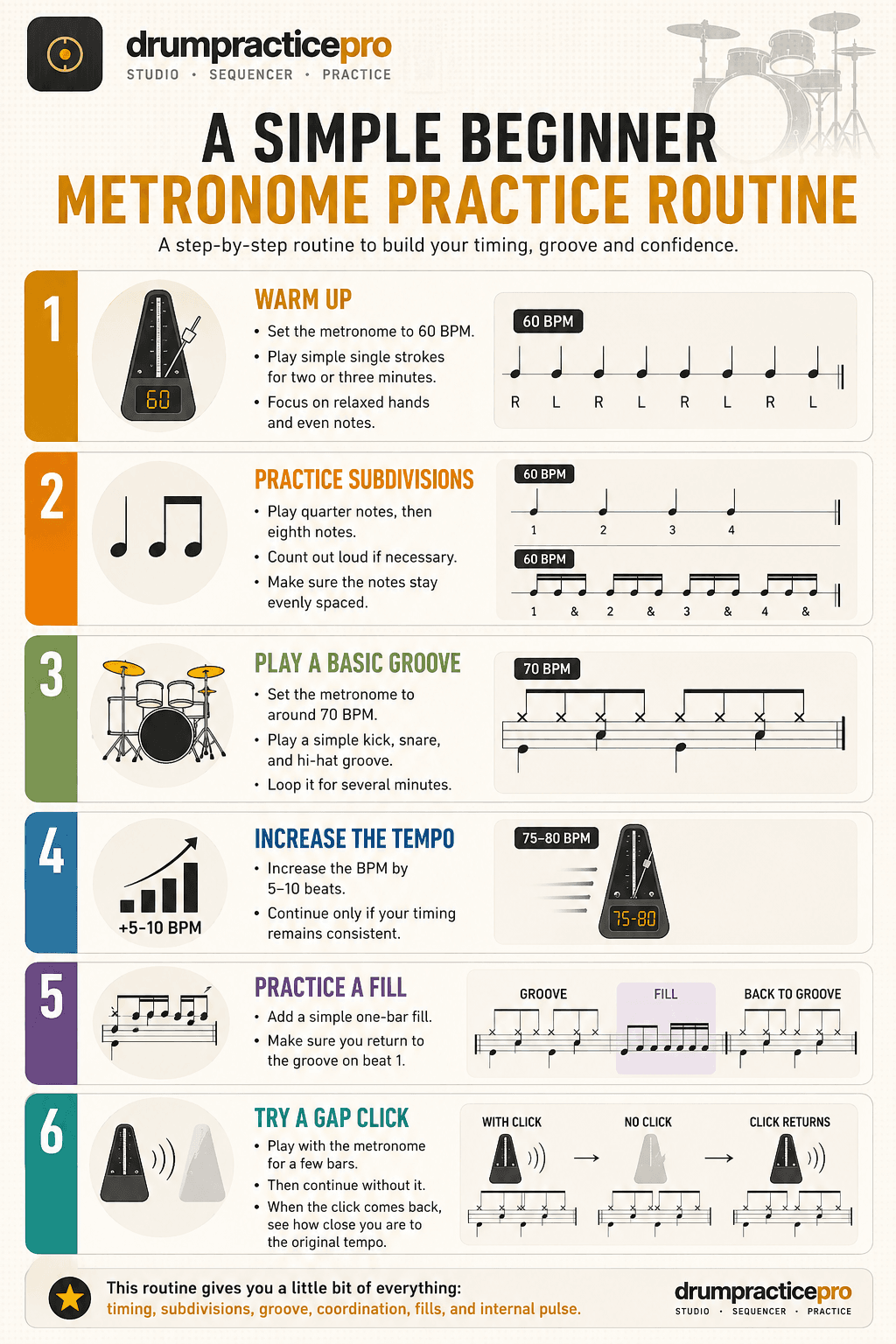
The six-step practice routine above, laid out as a quick-reference cheat sheet.
The Most Important Rule: Make the Click Part of Your Playing
The goal of practicing with a metronome is not to become dependent on a clicking sound.
The goal is to develop such a strong internal sense of time that you can keep a steady tempo even when the metronome is gone.
Think of the metronome as a teacher.
It gives you honest feedback.
If you are rushing, it tells you.
If you are dragging, it tells you.
If your groove is stable, it helps you confirm it.
Over time, you will start to feel the beat more naturally.
Final Thoughts
Learning how to practice drums with a metronome is one of the best things you can do for your drumming.
Start slowly. Keep your exercises simple. Listen carefully to the click and focus on playing consistently rather than playing fast.
Use the metronome with quarter notes, eighth notes, basic grooves, fills, rudiments, and different subdivisions. Gradually increase your BPM as your timing improves, and occasionally practice without the click to develop your internal sense of time.
Most importantly, be patient.
Good timing does not appear after one practice session. It develops through regular, focused practice.
With tools like DrumPracticePro, you can turn this into a structured routine: choose a groove, set your tempo, loop it, practice along with the click, and gradually challenge yourself with faster tempos and more difficult rhythms.
A few focused minutes of metronome practice every day can make a noticeable difference in how solid, confident, and musical your drumming feels.
Frequently Asked Questions
What BPM should a beginner use with a metronome?
There is no single correct BPM. For most beginners, 60–80 BPM is a good starting range. Choose a tempo where you can play accurately without tension or rushing.
Should I practice drums with a metronome every day?
You don't have to use it for your entire practice session, but regular metronome practice is highly recommended. Even 10–15 focused minutes can help improve your timing.
Should I practice slowly or quickly?
Start slowly. Once you can play a pattern accurately and consistently, gradually increase the BPM. Slow practice helps build control and accuracy.
Why do I speed up when I play drums?
You may speed up because of tension, excitement, difficult sections, or because your internal sense of time is still developing. Practicing slowly with a metronome can help you recognize and correct this.
Should the drum hit happen exactly with the metronome click?
When practicing quarter notes or playing directly on the beat, yes, your goal is to place the note accurately with the click. As you become more advanced, you can also practice playing intentionally slightly before or after the beat for different musical effects.
What should I do if I keep losing the beat?
Slow the tempo down. Simplify the exercise and count out loud. Once you can comfortably maintain the pulse, gradually add the other parts of the groove.
Can a metronome improve my drum timing?
Yes. Consistent metronome practice can help you develop a more stable tempo, better subdivision awareness, and a stronger internal sense of time.
Is it better to practice with a metronome or without one?
Both are useful. The metronome gives you an external reference for timing, while practicing without it helps you develop your internal pulse. Combining both methods is ideal.
← Back to guide